
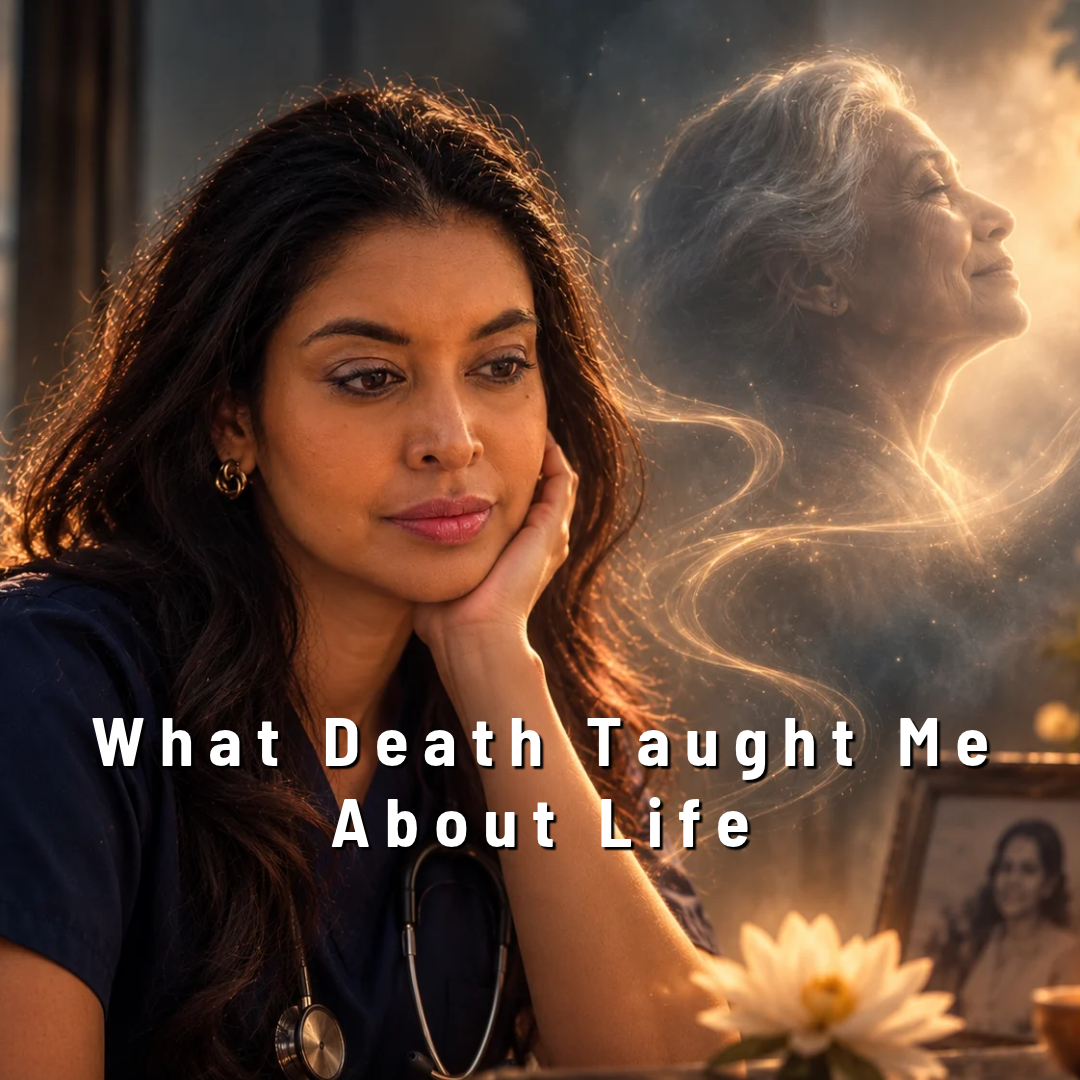
A Life Lived Close to Death
I have witnessed a great deal of death in my life.
More, perhaps, than most people will encounter in a lifetime. Some of it has been violent. Some unexpected. Some prolonged and agonising. And occasionally, extraordinarily peaceful.
My earliest encounters with death happened long before I had the language to understand it. By the age of eleven, all four of my grandparents, who had been enormously influential in my upbringing, had passed away. Two of them died in my presence.
I have often wondered whether this early intimacy with death changed something fundamental in me. Whether the way I understand life, the choices I have made, and even my eventual decision to practise emergency medicine were influenced by these encounters.
I cannot say for certain.
But there are two deaths that have remained with me all my life, not simply because of the people I lost, but because of the extraordinary manner in which they left.
My Grandfather and the Fifteen Minutes
My maternal grandfather was a gentle, serene man. My memories of his death are largely inherited from my mother, who still recounts the events with astonishing clarity.
He had not been seriously ill. One morning, he sat in our prayer area and began singing Muthineri, a Tamil devotional song associated with funerals and the yearning for liberation from the cycle of birth and death.
It was a strange choice of song for an otherwise ordinary morning.
My grandmother became concerned. There was no apparent reason for her concern and, when asked years later, she could only describe an inexplicable feeling that something “bad” was about to happen.
My grandfather had developed what seemed to be a mild, flu-like illness. There was nothing to suggest that he was approaching death, but my grandmother insisted that he be taken to a doctor.
My mother returned home from work to take him. When they arrived at the doctor’s rooms, the doctor was not there. My mother became increasingly agitated by the delay. Again, not sure why she was in a hurry.
My grandfather, apparently entirely unperturbed, asked her to calm down.
He told her that he had only fifteen minutes left. He was not speaking about the appointment. He was speaking about his life.
He died exactly 15 minutes after telling her that.
I have thought about this story countless times, particularly since becoming a doctor.
What did he know?
What was he experiencing that the people around him could not see?
How could a man with no apparent life-threatening illness, no known co-morbidities, speak of his impending death with such precision and composure?
I have no medical explanation for his apparent certainty. I have never felt particularly compelled to manufacture one.
Perhaps what fascinates me most is not that he appeared to know when he would die.
It is that he did not seem afraid. He sat in prayer, sang of liberation, and prepared to leave. As though he were going somewhere familiar.
My Grandmother, the Centre of My Universe
My grandmother’s death, eight years later, would leave an even deeper impression on me.
She died when I was eleven years old. My grandmother was, quite simply, the centre of my childhood universe. We shared a bedroom from the time I was born. Almost every night of my life, I fell asleep beside her, listening to her stories.
Her entire existence seemed to revolve around caring for us.
I don’t think I even knew how to comb my own hair when she died. Every morning, for as long as I could remember, she had done it for me.
She cared for me with a tenderness that I can only describe as tending to a flower.
She had previously suffered from cancer, and in the month before her death developed another illness. She complained of weakness on one side of her body, and we wondered whether she had suffered a stroke.
But then something unexpected happened. She began to recover.
And not just marginally. She improved so rapidly that she was eventually walking independently again. It appeared that she had made a remarkable recovery.
She believed that Sathya Sai Baba had cured her.
In the days leading up to her death, she seemed happy and at peace.
I remember her calling relatives, including people she had not spoken to in some time. She reminisced, laughed, exchanged stories, and spoke with a lightness that I had not heard in months.
She also began organising her belongings.
Her clothes were carefully arranged. She made sure we knew where everything was kept.
Looking back, I wonder whether she was putting her affairs in order.
At eleven, of course, I didn’t see any of this as preparation for death.
I thought she was getting better.
The Night She Left
On the night she died, I was studying for a school test in another room. It was unusual for me not to be sleeping beside her.
I heard a noise coming from our bedroom. When I went to investigate, she seemed to be having difficulty breathing.
I asked her what was wrong.
She told me not to worry. She asked me to call my father and then told me to go to sleep.
I did exactly as I was told. But something felt wrong.
A little while later, I heard my father moving around the house with unusual urgency. I came out again and asked what was happening.
He explained that Ma was unwell and that we needed to take her to hospital.
A neighbour was called to help carry her to the car.
I remember watching her.
She looked so peaceful.
On the drive to the hospital, I kept asking my father what was happening. I could sense that he was trying to prepare me for the possibility that she might die.
I refused to entertain it. She was sleeping, I insisted. She was just sleeping. By the time we reached the hospital, she was gone.
A Before and an After
There are moments in life that divide everything into a before and an after.
For me, this was one of them.
My mother had been diagnosed with cancer the previous year, and much of my childhood anxiety had already become entangled with the possibility of losing her. I had spent months mentally preparing for something no child should have to prepare for.
And then, unexpectedly, I lost my grandmother instead. The person who had made my world feel safe. I grew up very quickly after that.
But something about the manner of her departure has stayed with me, and it is only now, after years of witnessing death professionally, that I have begun to appreciate how unusual it was.
My grandmother had spent her life putting me to sleep.
Sometimes, when she needed to get up without waking me, she would carefully lift my head, slide a pillow beneath it, and quietly slip away.
I have returned to that memory often. Because, in some strange way, that is how she left this world.
She made sure we were cared for. She put her belongings in order. She spoke to the people she loved. And when it was time to leave, she asked me to go to sleep.
Then she quietly slipped away.
Meeting Death From the Other Side
Years later, I would encounter death from the other side.
In 2007, I was involved in a horrific road traffic accident.
I survived, but spent time in intensive care. I had extensive road rash and struggled to walk properly for some time afterwards.
Strangely, I do not remember this experience as a great spiritual awakening. I cannot honestly say that I emerged from the accident with some profound new understanding of life.
But one memory remains unusually vivid.
Someone covered me to keep me warm.
I remember an overwhelming sense of calm associated with that presence. Amid the violence, injury and confusion, there was something deeply reassuring about it.
Years later, Mohanji told me that he had saved my life on multiple occasions, including during road traffic incidents.
I have often wondered about that person who covered me.
And to this day, I feel that it was Mohanji.
I cannot prove this, nor do I feel the need to. It remains a deeply personal experience, one that has acquired meaning as my spiritual journey has unfolded.
What interests me, looking back, is that even in my own proximity to death, the strongest memory I retained was not of fear.
It was of being cared for.
Perhaps that is why the memory has stayed with me.
Death Through a Physician’s Eyes
I eventually became a doctor, and then an emergency physician.
It is an extraordinary profession when viewed through the lens of mortality.
Much of what we do is an attempt to predict death, interrupt its progression, or prevent it altogether. We learn to recognise the subtle physiological changes that precede collapse. We learn to identify which patients are about to deteriorate, often before they themselves are aware of it.
There is an extraordinary single-pointed focus that emerges when a human life is slipping away in front of you.
Everything else disappears.
Time contracts.
The room becomes an intensely coordinated effort to keep one person alive.
We compress chests, secure airways, administer medications, transfuse blood, and attempt to reverse the physiological processes that are shutting the body down.
And sometimes we succeed.
But even with the extraordinary advances of modern medicine, there is one reality we cannot escape.
We may postpone death. We may prevent a premature death. We may even bring someone back from the brink.
But we cannot abolish mortality.
I have now spent a substantial part of my life in the company of people who are dying.
What I Have Noticed at the Bedside
And there are things I have noticed.
Many patients approaching death develop a peculiar, distant gaze.
Their eyes appear to settle somewhere beyond the immediate surroundings. Sometimes they look past me, over my shoulder, or into an empty part of the room.
I have often wondered what occupies their attention in those moments.
There are physiological explanations for altered awareness in the dying process, of course. Hypoxia, cerebral hypoperfusion, metabolic disturbances and delirium can profoundly alter perception.
As a physician, I understand these mechanisms.
But as a human being standing beside another human being at the end of their life, I cannot help wondering about the subjective experience behind those eyes.
What does dying feel like from the inside?
Many patients ask for water.
Many struggle to breathe.
Some become intensely agitated, pulling at their oxygen masks, trying to sit upright, fighting for another breath.
There is something deeply distressing about watching a human being struggle against the failure of their own body.
Others die with astonishing abruptness.
A trauma patient may be speaking to you one moment, with observations that offer a deceptive degree of reassurance, and suffer cardiac arrest the next.
A stab wound to the heart can teach you, with brutal efficiency, how little time there sometimes is between life and death.
There have been moments when even I, despite years of training, have believed that we had more time than we actually did.
Death can be frighteningly unpredictable.
Faith, Struggle, and a Question Medicine Cannot Answer
And yet, despite the enormous number of deaths I have witnessed, I can recall remarkably few that resembled those of my grandparents.
There have been exceptions.
I remember an elderly woman who continued calling the name of Jesus, gently and continually, until the very end.
There was something beautiful about her devotion.
But so many others have died in distress, confusion or agitation.
At times, watching them, it has seemed as though they were struggling against something unseen.
I know that this is an interpretation, not a medical finding. What looks like resistance to death may be air hunger, delirium, pain, fear, or the body’s final physiological responses. We cannot know from outward appearances alone what someone is experiencing internally.
Still, the contrast has fascinated me for years.
I do not claim that spirituality makes death easier, nor that those who have lived spiritual lives necessarily experience a more peaceful departure. I have seen too much suffering, in too many different circumstances, to make such a sweeping assertion.
But I have observed, on occasion, that faith seems to offer something profoundly comforting to those approaching the end of life.
I cannot offer a medical explanation for this observation. Nor do I consider myself sufficiently spiritually evolved or knowledgeable to make any authoritative claims about what happens to consciousness at the moment of death.
It is simply something I have noticed over the years.
My grandparents seemed to have made peace with their departure before it arrived.
Others appear to struggle until the body can struggle no more.
And I find myself returning to a question that medicine cannot fully answer.
Is there a difference between the body dying and the person dying?
Two Ways of Knowing
The longer I have lived, the more I have come to see that my understanding of death has been shaped by two very different forms of knowledge.
Medicine has taught me about the death of the body.
Spirituality has invited me to contemplate the continuity of existence beyond it.
In the Hindu understanding of life, the body is temporary, but the Atman is not subject to birth and death in the same way.
The Bhagavad Gita describes the embodied being relinquishing a worn-out body as a person discards old garments and puts on new ones.
It is an extraordinarily simple analogy for something so difficult to comprehend.
And yet, I think its deeper meaning is easily overlooked.
We spend so much of our lives identifying with the body, its experiences, its relationships, its pleasures and its suffering, that the possibility of existence beyond it can feel almost incomprehensible.
Even when we intellectually accept the immortality of the soul, we may remain profoundly attached to the life we know.
I have begun to wonder whether the art of dying is inseparable from the art of living.
Whether the way we live, the attachments we cultivate, the fears we carry, and the degree to which we learn to surrender might influence how we meet our final moments.
Not necessarily whether the body dies peacefully. Biology is too complex, and suffering too unevenly distributed, for us to make that assumption.
A person who struggles to breathe is not necessarily spiritually unprepared. Nor is someone who dies serenely necessarily more spiritually evolved.
But perhaps there is another kind of readiness, one that cannot always be seen from the outside.
My grandfather sang of liberation before his death.
My grandmother spent her final days speaking to loved ones and putting her world in order.
Perhaps neither of them regarded death as an interruption.
Perhaps, in their own ways, they understood it as a transition.
I find that possibility deeply comforting.
A Doorway, Not an Ending
Mohanji’s teachings have given me another way of reflecting on these experiences: the importance of awareness, acceptance, detachment and liberation from the patterns that bind us to repeated existence.
If life is a journey of evolution in consciousness, death cannot simply be viewed as its opposite.
It becomes part of that journey.
A doorway.
Not necessarily the end of learning, nor a guarantee of liberation, but a transition whose deeper significance we may not yet understand.
And perhaps the purpose of spiritual practice is not merely to prepare us for death.
Perhaps it is to help us live so completely, so consciously, and with so little resistance to the nature of existence, that when the time comes, we do not feel that life has been taken from us.
We recognise that a chapter has ended.
Somewhere I Could Not See Her
I think about my grandmother often.
Not the moment she died, but the thousands of ordinary evenings when she put me to sleep.
The gentle movement of her hands as she placed a pillow beneath my head.
The care she took not to disturb me.
The quiet way she left the room.
For much of my childhood, I believed that when she left the room, she was gone.
But she was never really gone.
She was simply somewhere I could not see her.
And perhaps that is the image I will always carry when I contemplate death.
Not an ending that must be fought at all costs.
Not a mystery that I can claim to have solved.
But the possibility that what we experience as a departure may be something quite different from the perspective of the one who leaves.
That death, like birth, may be a passage into a form of existence we cannot yet comprehend.
And that the real work of a lifetime may be learning how to let go.
Leave a Reply