
In the first part of this series, we explored what narcissism actually is and why the word has become so misunderstood. In Part 2, we looked at how narcissistic patterns can show up in everyday behaviour, and why they aren’t always as obvious as the stereotype suggests. But understanding the pattern is only the beginning. In Part three we ask the more important question: What do you actually do when you recognise it?
Knowing that someone may have strong narcissistic traits doesn’t automatically tell you how to respond. And if you’re not careful, trying to understand another person’s behaviour can become another way of losing yourself in it. This is where self-awareness, boundaries, psychology, and, perhaps surprisingly, spirituality begin to overlap.
Start With Yourself
Before looking at what to do about someone else’s behaviour, it’s worth turning the attention inward. We all have narcissistic traits. We all want to be appreciated, enjoy recognition, and have moments when criticism feels uncomfortable or when our ego gets in the way of seeing another person’s perspective. The difference isn’t whether these traits exist. It’s what we do when we notice them.
If you recognise some of these patterns in yourself, that doesn’t automatically make you a narcissist. In fact, the ability to question your own behaviour is an important part of psychological growth. Real self-awareness begins when we become curious about the parts of ourselves we’d rather defend. Why does criticism affect me so strongly? Why do I need other people’s approval to feel worthy? Why do I struggle when someone else succeeds? These aren’t always comfortable questions, but they can be incredibly valuable ones.
The goal isn’t to eliminate the ego. That’s neither realistic nor necessary. It’s to become aware enough that the ego doesn’t run your life. That might mean learning to pause before reacting to criticism, becoming genuinely curious about another person’s experience, taking responsibility without immediately defending yourself, and developing a sense of worth that doesn’t depend entirely on how other people see you. Psychological growth often begins with the simple ability to say, “Maybe I’m part of the problem too.” That requires humility, but it can also be transformative.
When the Pattern Belongs to Someone Else
Things become much more complicated when you’re dealing with these patterns in another person. You cannot force someone into self-awareness, argue someone out of a deeply ingrained defence mechanism, or love someone enough to make them change.
This is particularly important when dealing with entrenched narcissistic patterns. Meaningful change generally requires the individual to recognise their own behaviour and become willing to work on it. Without that willingness, repeated confrontation often creates more conflict without creating more insight.
So instead of asking, “How do I get them to understand what they’re doing?”, a more useful question may be, “How do I decide what I am willing to participate in?”
That shift changes everything.
Choose Boundaries Over Arguments
One of the biggest mistakes people make in difficult relationships is believing that if they can just explain themselves clearly enough, the other person will finally understand. Sometimes they will. Sometimes they won’t. If someone repeatedly dismisses your perspective, twists your words, refuses accountability, or turns every disagreement into an argument about your character, explaining yourself for the tenth time rarely produces a different result.
A boundary isn’t an argument. It’s a decision. You don’t need someone to agree with your boundary for it to exist. You can simply decide what you will and won’t tolerate and communicate that clearly. The purpose of a boundary isn’t to control another person. It’s to clarify what you will do.
That distinction is important because boundaries are ultimately about your behaviour, not theirs.
Stop Carrying What Isn’t Yours
Another pattern that can develop in difficult relationships is emotional over-functioning. You begin managing their moods, choosing your words carefully to avoid triggering them, apologising simply to restore peace, and taking responsibility for emotions that aren’t actually yours to carry. Eventually, you can become so focused on keeping someone else regulated that you lose touch with your own emotional state.
Protecting yourself therefore means asking a difficult but important question: “What am I taking responsibility for that actually belongs to someone else?”
Their anger is theirs. Their disappointment is theirs. Their interpretation of events is theirs. Their emotional reaction to your boundary is theirs. You can care about someone without taking ownership of their inner world. That isn’t selfishness. It’s emotional differentiation, and it allows you to remain connected to another person without becoming responsible for everything they feel.
When Distance Isn’t Possible
Sometimes leaving isn’t an option. It might be a colleague, a family member, a co-parent, or someone you still need to interact with regularly. In these situations, one strategy people sometimes use is known as the grey rock approach.
The idea is to become less emotionally reactive and less engaging when faced with attempts to provoke conflict or draw you into unnecessary drama. Your responses remain calm, brief, and relatively neutral. The purpose isn’t to punish the other person or play psychological games. It’s simply to reduce the amount of emotional material available for conflict when you can’t easily walk away.
But this shouldn’t become another form of suppression. Protecting yourself doesn’t mean becoming emotionally numb. It means becoming more intentional about where you invest your emotional energy. And if a relationship involves serious emotional, psychological, or physical harm, your safety should always come first, along with seeking appropriate professional support.
Don’t Lose Your Sense of Reality
One of the most difficult aspects of unhealthy narcissistic dynamics can be the gradual erosion of self-trust. You may begin questioning your memory, your judgement, and even your emotional reactions. You might find yourself constantly asking, “Am I overreacting?”, “Was it really that bad?”, “Maybe I misunderstood,” or “Maybe it’s actually my fault.”
This is one reason outside perspectives can be so valuable. A trusted friend, therapist, psychologist, or someone who can listen without being caught inside the dynamic can help you step outside of the emotional fog and see things more clearly. You don’t necessarily need someone to tell you what to think. Sometimes you simply need a safe place where you can think clearly again.
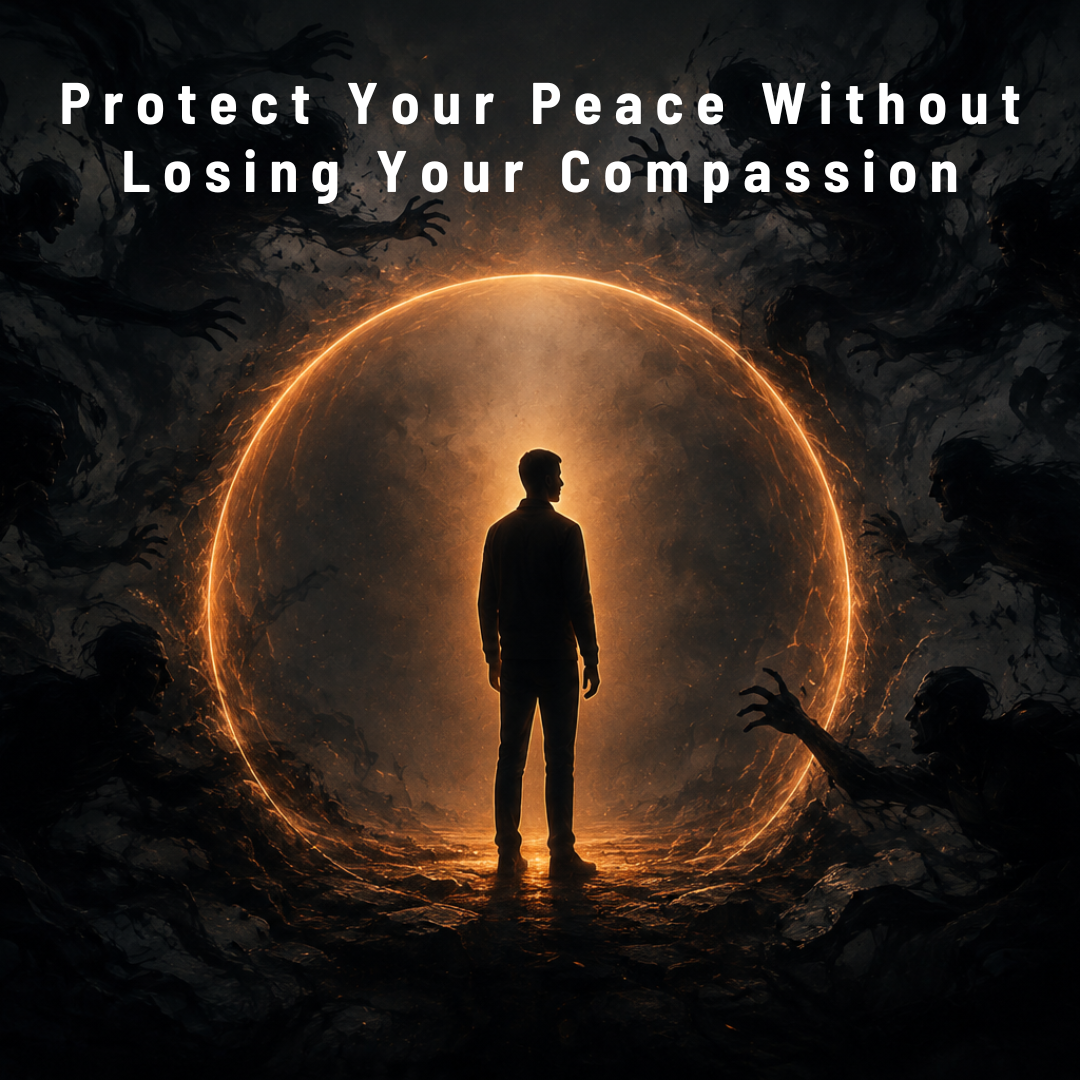
Protecting Your Energy Without Losing Your Compassion
This is where the psychological and spiritual sides of this conversation begin to meet.
The phrase “protect your energy” has become popular in modern wellness culture, but the underlying idea is much older. Across contemplative and spiritual traditions, there is a recurring practice of witnessing without becoming entangled. You observe what is happening without immediately becoming what is happening. Someone can be angry without you becoming angry. Someone can be chaotic without you becoming chaotic. Someone can project their pain onto you without you accepting that pain as your identity.
This isn’t emotional detachment in the sense of not caring. It’s awareness without absorption.
And there is an important distinction here. Spirituality should never become an excuse to tolerate harmful behaviour. Sometimes we can fall into the trap of believing that being compassionate means we have to forgive immediately, understand someone’s trauma, or simply rise above what they’ve done. Those things can be meaningful, but compassion does not require the absence of boundaries.
Understanding someone’s wound doesn’t mean allowing them to use that wound as a weapon. You can see the pain behind someone’s behaviour without excusing the behaviour itself. You can understand where someone came from without allowing where they came from to determine where you are going.
That is not a lack of compassion. It is compassion with discernment.
The Difference Between Loving Someone and Losing Yourself
Perhaps this is the deeper lesson beneath everything we’ve explored in this series. We often think love means accepting someone completely, but acceptance doesn’t mean accepting everything someone does.
You can love someone and still say no. You can understand someone and still create distance. You can forgive someone and still decide they no longer have access to you. You can have compassion for someone’s wounds without volunteering to be wounded by them.
There is a difference between loving someone and disappearing into them. Healthy compassion leaves room for two people to exist. Self-erasure only leaves room for one.
Where This Leaves Us
After everything we’ve explored across these three parts, perhaps the most important thing isn’t learning how to spot a narcissist. It’s learning how to recognise patterns: in ourselves, in the people around us, and in the relationships we create.
Narcissism exists on a spectrum. We all have moments of self-focus, defensiveness, insecurity, and the desire to be seen. The question is what happens when those tendencies become rigid. When accountability disappears, when empathy repeatedly gives way to self-protection, and when another person’s needs become secondary to maintaining a particular image of oneself, the pattern becomes something far more serious.
The answer isn’t to become obsessed with identifying narcissists. It’s to become more psychologically aware. To know the difference between understanding and excusing, between compassion and self-sacrifice, between forgiveness and allowing repeated harm, and between protecting your peace and simply avoiding difficult emotions.
Ultimately, the goal was never to become better at labelling people. It was to become better at understanding ourselves and the people around us.
The more deeply we understand human behaviour, the less we need labels to make sense of it.
And perhaps that’s where psychology and spirituality meet. Psychology teaches us to observe the patterns. Spirituality teaches us not to become lost in them. Together, they can help us develop something far more valuable than the ability to spot a narcissist: the wisdom to know what is ours to carry, what isn’t, and when it’s time to let go.
Beyond the Label (What do you actually do when you recognise it?)
•
Leave a Reply