
It is often expressed that depression, at least in some sense, can become a form of selfishness. Not selfishness in the ordinary sense of being inconsiderate or self-serving, but in the sense of a mind so consumed by its own pain that it stops seeing anyone else’s. Taken literally, that idea is too simplistic, and when applied to clinical depression it can be deeply harmful. Depression is not a character flaw, a lack of gratitude, or a failure to simply think differently. But underneath the provocative statement is a question worth taking seriously: what happens when our attention becomes so absorbed in our own suffering that the self becomes the entire field of vision?
There is something psychologically real about the way suffering can turn inward and begin to reinforce itself. When something hurts, we naturally try to understand it. We replay what happened, analyse what we could have done differently, imagine alternative outcomes and search for an explanation. Reflection can be useful when it leads to understanding or action. But there is a point where reflection becomes rumination, where we are no longer processing an experience, but repeatedly circling the same thoughts, emotions and questions without moving anywhere.
The more attention we give those thoughts, the larger they can begin to feel. Our problems become more vivid, our shortcomings more obvious and our circumstances more overwhelming. The world outside of us doesn’t necessarily change, but our experience of it does. Our attention has narrowed, and what occupies our attention begins to feel like the whole of reality.
This is an important distinction. It isn’t that someone experiencing depression is selfish. It is that suffering can sometimes make the world feel very small. When you’re hurting, it can become difficult to see beyond the immediate experience of being hurt. Other people’s problems become distant. Possibilities become harder to imagine. Even things that once gave you perspective can begin to feel irrelevant. The self isn’t necessarily being prioritised out of choice; it can simply become the place where all of your attention is trapped.
That distinction matters because shame is rarely a useful response to suffering. Telling someone that they are selfish for being depressed adds another layer of judgement to an already painful experience. It can make a person feel guilty not only for suffering, but for failing to suffer in the “right” way. That is not the answer.
The potential you never used
But there is another form of dissatisfaction that is easier to overlook because it doesn’t always look like suffering. Sometimes a person can have a relatively comfortable life and still feel deeply restless. Nothing is obviously falling apart. There may be no single event to point to. Yet something feels missing. There is a persistent sense of being underused, disconnected or somehow out of alignment with one’s own life.
Sometimes what we experience as dissatisfaction is not necessarily a sign that everything around us is wrong. It may be a sign that too little of what is inside us is being expressed.
We all have capacities that can remain dormant for years: creativity, intelligence, curiosity, courage, empathy, discipline, leadership, the ability to build something, teach something or contribute to something larger than ourselves. When those capacities have nowhere to go, life can begin to feel strangely flat. Comfort can coexist with dissatisfaction because comfort and fulfilment are not the same thing.
Alfred Adler, the founder of individual psychology, argued that human beings are driven by a need to overcome feelings of inferiority through contribution and mastery. What he called Gemeinschaftsgefühl, or social interest. Abraham Maslow later described self-actualisation as the process of becoming what one is capable of becoming, and Mihaly Csikszentmihalyi’s research on “flow” found that people report their highest sense of aliveness not during leisure, but during demanding, purposeful activity that uses their skills fully. Put plainly, a life with too little challenge and too little contribution isn’t restful. It’s corrosive. Unused potential doesn’t sit quietly; it presses on you, and if you don’t recognize it, you can easily mistake it for something wrong with you rather than something missing from your days.
Put it simply: a life can become psychologically uncomfortable when there is a persistent gap between what we are capable of and how we are actually living.
Sometimes the question isn’t, “Why am I unhappy?” It is, “What part of me isn’t being used?”
The Comparison Trap
Human beings have always compared themselves with others. Social comparison theory, developed by psychologist Leon Festinger in the 1950s, described our tendency to evaluate ourselves in relation to other people. We don’t simply ask whether our lives are good in isolation. We ask whether they are good relative to the lives we see around us.
The problem is that we rarely compare ourselves objectively.
We compare our ordinary reality with someone else’s most visible achievements. We compare our uncertainty with their confidence, our unfinished work with their finished product, our private struggles with their public image. And because there will almost always be someone who appears further ahead, comparison can create a permanent sense of inadequacy.
You can have a good life and still feel like you’re failing at it.
Nothing about your circumstances has to change for that feeling to appear. Sometimes all that changes is the reference point you’re using to measure yourself.
This is one reason gratitude can be more psychologically significant than it first appears. Research by psychologists Robert Emmons and Michael McCullough (2003) found that people who kept regular gratitude journals reported meaningfully better wellbeing than those who didn’t, not because their circumstances changed, but because their frame of reference did. Gratitude pulls your attention back to what’s actually in front of you, rather than what’s in front of someone else.
Without gratitude, the mind can become organised around deficiency. What do I not have? What haven’t I achieved? Where am I behind? Who is doing better? What should my life look like by now?
There is no natural endpoint to those questions. Even when one goal is reached, comparison simply moves the horizon further away.
And this brings us back to the idea of looking beyond ourselves.
One of the most powerful ways to interrupt an inward spiral is to become useful to someone else. Not because helping another person magically cures depression, and certainly not because someone who is suffering should simply “get over themselves,” but because contribution changes the direction of our attention.
When we are caught in rumination, our attention tends to revolve around questions such as: What is wrong with me? Why did this happen to me? Why am I not where I should be? Why does everyone else seem to have it figured out?
Contribution asks a different question: What can I give?
That is a subtle but profound shift.
Why service actually works
For a moment, the focus moves away from evaluating the self and toward participating in life. Your attention is directed toward another person, a problem that needs solving, a skill that can be used, a piece of work that matters or something that can be created. You are no longer simply asking whether your life is good enough. You are doing something with the life you have.
This is part of why meaningful contribution can feel so different from passive distraction. Distraction gives the mind somewhere else to hide. Contribution gives it somewhere meaningful to go.
There is also something humbling about helping someone. Comparison tends to make us look upward, toward everything we don’t have. Service can make us look outward, toward what we can offer. It reminds us that our value isn’t determined entirely by what we have achieved, how impressive our life looks or where we stand relative to somebody else.
We can be useful before we are successful.
We can contribute before we have everything figured out.
We can give something even while parts of our own life remain unresolved.
That doesn’t mean we should ignore our own needs. There is a difference between healthy contribution and constantly abandoning yourself for other people. The point isn’t to escape yourself by becoming endlessly useful. It is to develop a relationship with yourself that isn’t completely centered on self-evaluation.
Perhaps that is the deeper lesson hidden inside the original provocation.
The problem isn’t that people who suffer care too much about themselves. The problem is that the human mind can become trapped in itself.
It can become trapped in what happened, what should have happened, what someone else has, what we don’t have, who we think we should be and why our life doesn’t look the way we imagined it would.
And the longer we stare at those questions, the more important they can seem.
Sometimes the way forward isn’t forced positivity. It isn’t telling yourself that everything is fine when it isn’t. It isn’t pretending to be grateful when you’re hurting.
Sometimes it is simply widening the frame.
Viktor Frankl, writing from the most extreme circumstances imaginable in a concentration camp, argued that meaning, not comfort, not pleasure — is what makes suffering survivable. Frankl’s core claim in Man’s Search for Meaning was that those who found something or someone to live for outlasted those who didn’t, psychologically as well as physically. Service is one of the most reliable, repeatable ways ordinary people manufacture that sense of meaning on a Sunday afternoon, without needing a crisis to force it into view.
So look at what is still possible. Notice what is already present. Find something worth building. Use a capacity that has been sitting dormant. Give someone your attention. Help where you can. Create something. Learn something. Become useful to something larger than the story currently playing inside your head.
Not because your pain isn’t real, but because your pain is not the whole of you.
There is a world outside of the mind’s current preoccupation. There are people who need something you may be able to give. There are parts of yourself that may still be waiting to be expressed. And there are experiences, relationships and possibilities that cannot be seen clearly when all of your attention is turned inward.
Perhaps the more useful question, then, isn’t simply, “How do I stop feeling this way?”
Perhaps it is also:
“What is my attention serving?”
Because where attention goes, life tends to follow.
And sometimes, the beginning of an outward life is simply learning to look beyond yourself again.
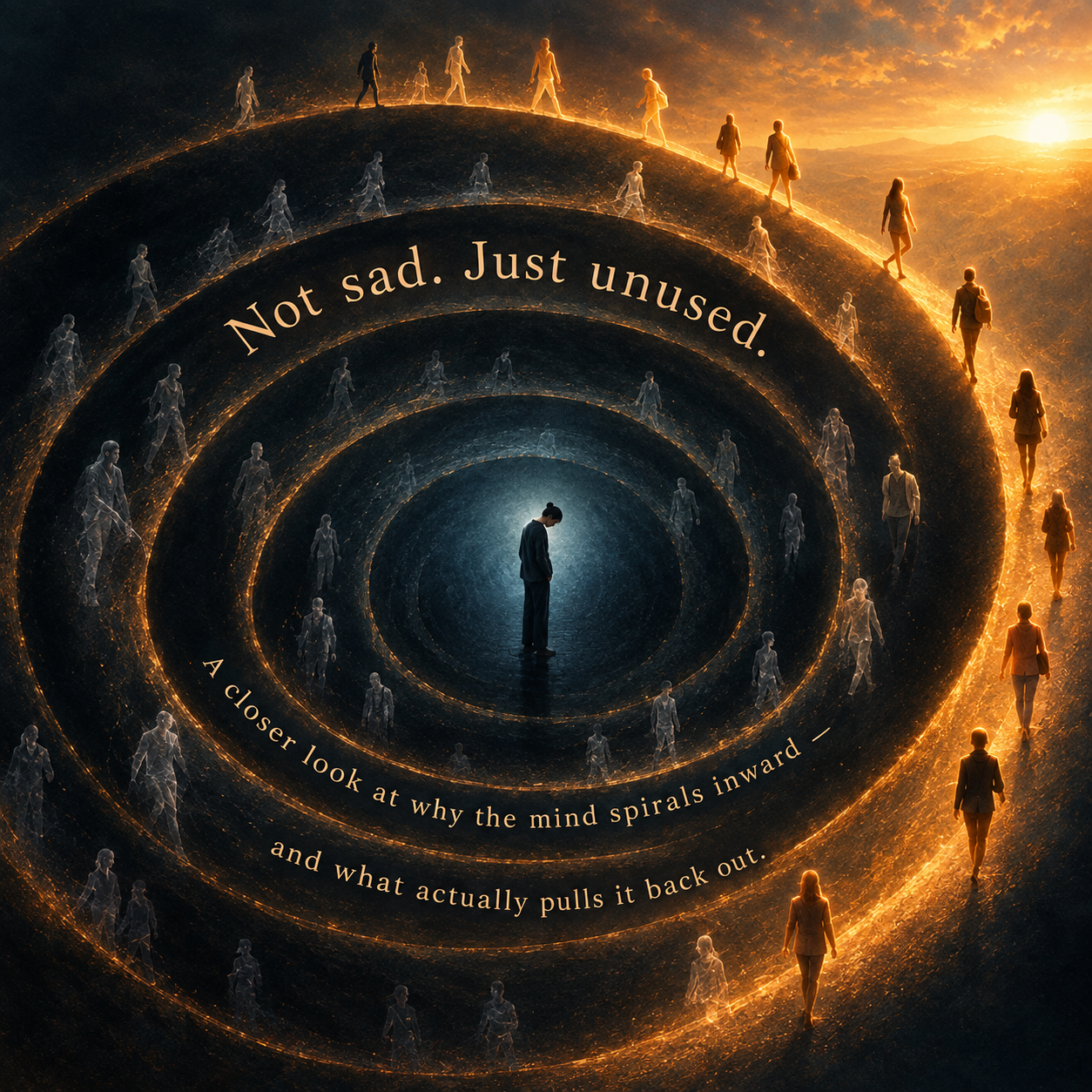
The Inward Spiral: Depression, Unused Potential and the Trap of Comparison
•
Leave a Reply