
Part one of a three-part series on narcissism.
Say the word “narcissist” out loud and watch what happens. A face comes to mind. An ex, a boss,a manipulative friend, a parent, maybe. It’s become a label we place on people who have hurt us, a way of drawing a line between them and us. Someone else’s problem, filed neatly under them, not me.
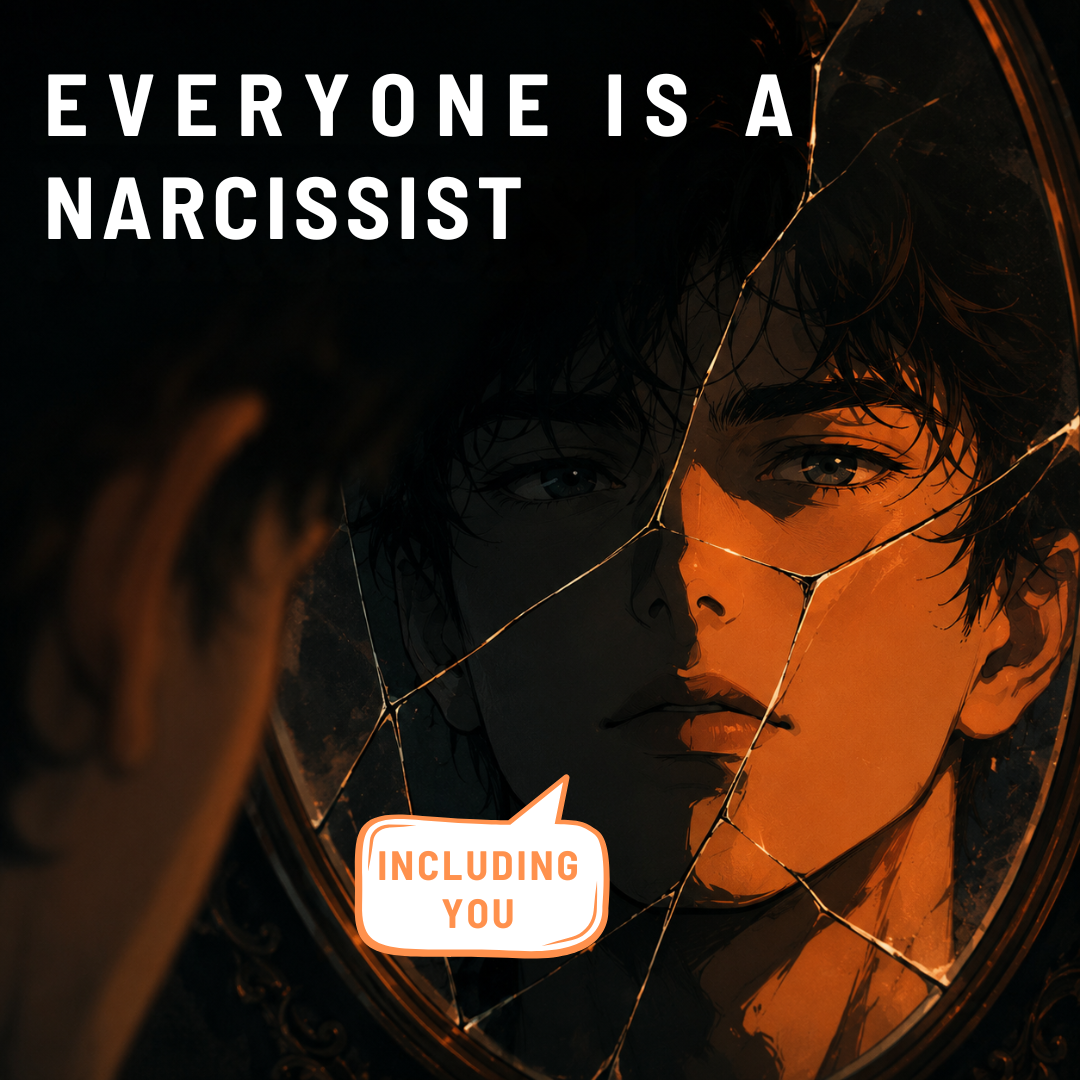
But narcissism was never meant to describe a rare, villainous type of person. Long before it became internet shorthand for “toxic,” it was a word psychologists used to describe something far more universal, a form of self-love that begins in every single one of us, and only in some people hardens into something harmful.
Understanding that difference changes the whole conversation. It stops being about spotting the enemy, and starts being about understanding a very human dynamic that all of us are, in some form, a part of.
The self-love nobody escapes
As infants, we begin life believing we are the world. There’s no separation between self and everything else. Hunger, comfort, need, want, all of it orbits a single point, and that point is us. Developmental psychologists call this primary narcissism, and it isn’t a flaw. It’s simply how a self begins to form.
What happens next depends heavily on what we receive from the people who raise us. A child who is seen, mirrored, and steadily loved starts to build something durable, a sense of self that doesn’t require constant outside proof. An inner home, a stable sense of self. They learn that they are valuable even when nobody is applauding them. Even when they fail. Even when they disappoint someone. But not every child receives that gift.
A child who is inconsistently loved, over-praised, praised only when they perform, ignored, or used to meet a parent’s own emotional needs doesn’t get that luxury. They become invisible, their identity never gets the chance to settle. The self stays fragile, unfinished and spends years afterward looking outward for what it never got to build inward. Instead of discovering who they are, they spend their lives trying to earn permission to exist.
The Hidden Wound Beneath Narcissism
This is the thread that runs through most serious thinking on narcissism, it was never really about vanity. It’s about how cohesive a person’s sense of self is and almost nobody’s is perfectly whole.
This is why narcissism has never truly been about vanity. Vanity is only the symptom. The deeper wound is insecurity. Not the ordinary insecurity we all feel from time to time, but an unstable relationship with the self. Imagine trying to fill a bucket with no bottom. No amount of praise is enough. No achievement lasts. No relationship finally satisfies, because what is missing was never outside. It was never applause. It was never an admiration. It was never powerful. It was an inner foundation that wasn’t allowed to fully form. This is why criticism feels unbearable to some people. Why rejection feels like annihilation. Why being ignored feels like disappearing. They’re not protecting confidence. They’re protecting something painfully fragile.
A spectrum, not a label
Most contemporary psychologists frame narcissism as existing on a continuum rather than a strict on/off category. A useful way to think about the range:
On the more difficult end, some people’s sense of self never fully solidifies, so it has to be constantly rebuilt from the outside through attention, admiration, control, or being right. Criticism doesn’t land as feedback; it lands as a threat to something already unstable. Everything gets taken personally. These are often people who are unusually skilled at reading and managing others, not necessarily out of malice, but because their world revolves around protecting an identity that never feels secure.
Most of us sit somewhere in the middle. We have a real, workable sense of self, but it isn’t bulletproof. We have days where we need to be told we did well. Moments where someone else’s success stings more than it should. Flashes of defensiveness when we’re challenged. The desire to be recognised. None of these make us narcissists. They make us human.
Growth begins the moment we can witness those reactions instead of becoming them. Then there are those who gradually redirect their energy outward. Their confidence no longer depends on being seen. Their sensitivity becomes compassion, empathy and kindness instead of self-protection. They don’t stop loving themselves. They simply stop needing everyone else to prove they are lovable.
This is roughly the argument author Robert Greene makes in The Laws of Human Nature, where he goes as far as to say everyone carries some degree of narcissism. The real question isn’t whether you have it, but where you currently sit on the scale and which direction your self-focus tends to travel. Whether they are becoming smaller or larger. It’s a useful, if unusually blunt, way of stating what psychologists have circled for decades: this isn’t a condition confined to a handful of difficult people. It’s a dial every one of us has a hand on.Contemplative traditions have been describing this same spectrum for far longer than modern psychology has, just in different languages.
Why the “we all have it” framing isn’t a cop-out
It would be easy to hear this and think: great, so everyone’s a narcissist, nobody’s accountable, moving on. That’s the opposite of what’s useful here.
Recognizing narcissism as a spectrum doesn’t excuse the people doing real, lasting damage on the more severe end of it, that’s a distinct and serious pattern we’ll get into in Part 2. What it does is shift the more private, everyday question away from am I dealing with a narcissist and toward something you actually have influence over: where am I standing right now, in this relationship, under this amount of stress and which direction is my own sensitivity pointing?
That question tends to be more useful precisely because it’s the one you can act on.
Turning inward sensitivity outward: Where Psychology Meets Spirituality
Long before neuroscience explored identity, the sages of India asked a different question.
Who are you before every label?
Before success. Before failure. Before your career. Before your relationships. Before your trauma. Before the story you’ve spent your entire life defending.
They called the constructed identity ahamkara.
The ego. Not because it is evil.But because it mistakes the costume for the actor. Psychology tells us the ego develops to protect us. Spirituality reminds us it was never meant to imprison us. This is where the two paths quietly meet. Both recognise that suffering begins when we believe our identity depends on what the world reflects back to us. Meditation is not about destroying the ego. Yoga is not about becoming someone new. Self-inquiry is not another self-improvement project. They are acts of remembrance. A gradual returning to the awareness that existed before comparison ever entered the mind. The deeper Self, the one Vedanta calls atma or soul, needs no validation because it was never incomplete. It simply became hidden beneath years of conditioning.
How to turn the dial
The beautiful truth is that the same sensitivity capable of becoming narcissism is also capable of becoming compassion. The energy doesn’t disappear. It changes direction. Instead of asking, “How do people see me?” you begin asking, “What is this person carrying that I cannot see?” Instead of protecting your identity, you begin expanding your awareness. Instead of needing significance, you discover presence. None of it is complicated. All of it takes effort, especially on the days your own sense of self feels shakiest, which, not coincidentally, tend to be exactly the days it matters most.
Not because serving others makes you morally superior. But because every genuine act of service weakens the illusion that life revolves around “me.” Every moment of compassion loosens the grip of the ego. Every act of presence reminds us that love expands while self-importance contracts. Perhaps that is the deepest cure for narcissism. Not thinking less of yourself. Not thinking more of yourself. But remembering there is something within you far greater than the self you’ve spent your whole life defending.
Coming Next
In Part two, we’ll move from the universal human experience into the clinical reality of Narcissistic Personality Disorder. Exploring the difference between healthy narcissism and pathology, and Understanding the different faces of narcissism.
The Narcissist in the Mirror: Why Self-Love Isn’t as Simple as We Think
•
Leave a Reply